


Over the years, I’ve come to understand that I am not here so much to teach as I am to help create the conditions for what is already there to emerge. To create the kind of environment where children can remain connected to the parts of themselves they naturally arrive with: curiosity, compassion, creativity, cooperation, and an instinct to care for one another. My role has become less about teaching and more about protecting and nurturing these inborn ways of being long enough for them to take root.
At the beginning of every school year, this can feel like impossible work. There are tears and conflicts and children unsure where they fit. Some move loudly through the space while others quietly disappear into corners. Much of our work early on has very little to do with activities or lessons and much more to do with helping each child feel safe, seen, appreciated, and loved exactly as they are while also tending carefully to the emotional life of the group itself.
Then something begins to happen.
Recently, a group of children had been struggling with one of their elaborate playground games which has evolved over the school year in to something quite sophisticated. Complex family dynamics, dark forces to overcome, same sex cheetah parents, a found baby dragon that's been growing before our eyes.
There had been disagreements about fairness, hurt feelings, and growing frustration that had carried on for a few days. Without any adult involvement, a few of the children decided what was needed was a group meeting. One of many this year and something modeled and encourage to start every year. So a grand announcement was made. Everyone was required to be there and they gathered together while my teacher and I simply sat nearby and watched.
The children took turns explaining what had happened. They debated fairness. They worked through hurt feelings. They listened, disagreed, clarified, and slowly found their way toward a solution. In the end, apologies emerged naturally and all I really did was briefly summarize what I had heard before they returned to their game.
What continues to strike me after all these years is that children often spend more time doing this than actually playing. They negotiate who gets to be what character, work through rules, discuss fairness, navigate disappointment, and repair relationships. Then eventually they return to the game.
Sometimes I wonder if this is the game.
Maybe all the negotiating, fairness, frustration, repair, and figuring out how to exist together was never separate from play at all.
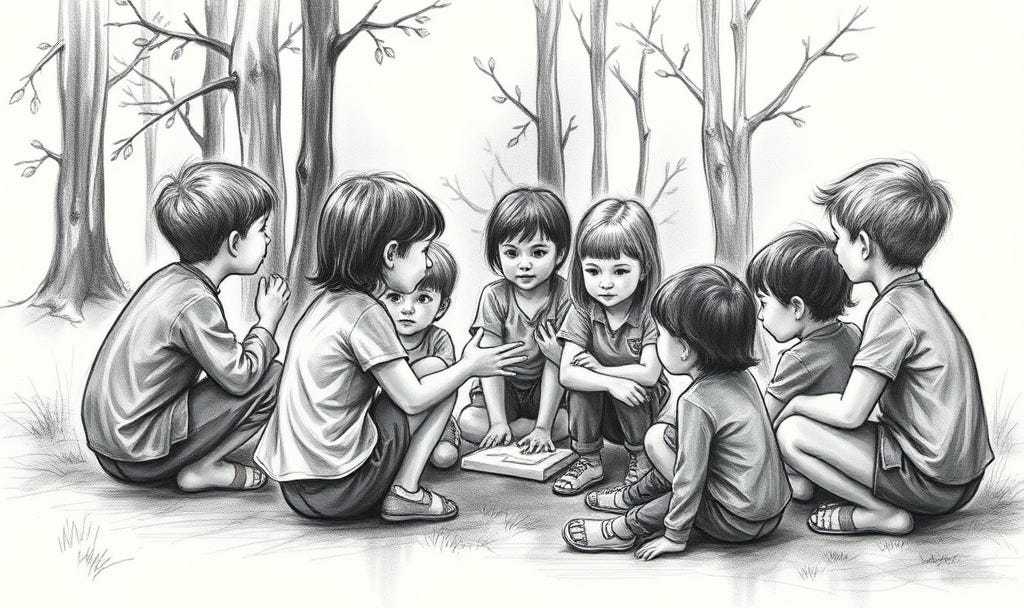
To me, it simply feels like nature taking its course and vital practice for what’s to come.
In my observations once enough connection and trust exist, groups begin regulating themselves. The quieter children find their voice. Children who once required constant support begin offering it to others. Problems start getting solved before adults arrive.
The quieter children finding their voice resonates deeply with the quiet child I once was and how I never truly found my voice. In a way my journey of transformation was the same as I eventually found my true voice and enough community who appreciated it.
My teachers and I have found ourselves lately spending more time simply sitting and watching, not because we are needed less, but because the community itself has become strong. Thirty years ago, I probably would have stepped in much sooner. Experience has slowly taught me that sometimes the hardest and most important work is simply staying close enough to help while trusting the process unfolding in front of you.
Sure, we still step in occasionally. There are always children experimenting with leadership in ways that require adult support and moments when the group needs help finding its way back to itself. But those moments become fewer. Mostly what we witness is something much more beautiful: human beings remembering who they are when given the right conditions.
Watching children grow within this kind of community sometimes leaves me hopeful in ways that are difficult to explain. If this much cooperation, compassion, creativity, and problem solving already exists within us at four and five years old, perhaps our task is not so much teaching these things as learning how to protect them. In learning how to create educational systems that prioritize this kind of practice and learning. Instead of allowing fear to guide us why not try trusting and supporting what is already there.
And the longer I do this work, the harder it becomes not to notice that many of the conditions that help children thrive also resemble what my own wounded parts were searching for long ago: community, patience, belonging, flexibility, shared responsibility, and people willing to stay close when things become difficult.
Perhaps without fully realizing it, I have spent thirty years trying to build the kind of community I wish had surrounded me.
A model for how to better support the whole child and community values but also a model in how we show up and support each other, especially during times of crisis.
And maybe a better society has been trying to show itself to us all along—out there on the playground, sitting cross legged in the dirt arguing about fairness.
Much Love!
The Mad Preschool Teacher (He/Him)
Yes, if only